
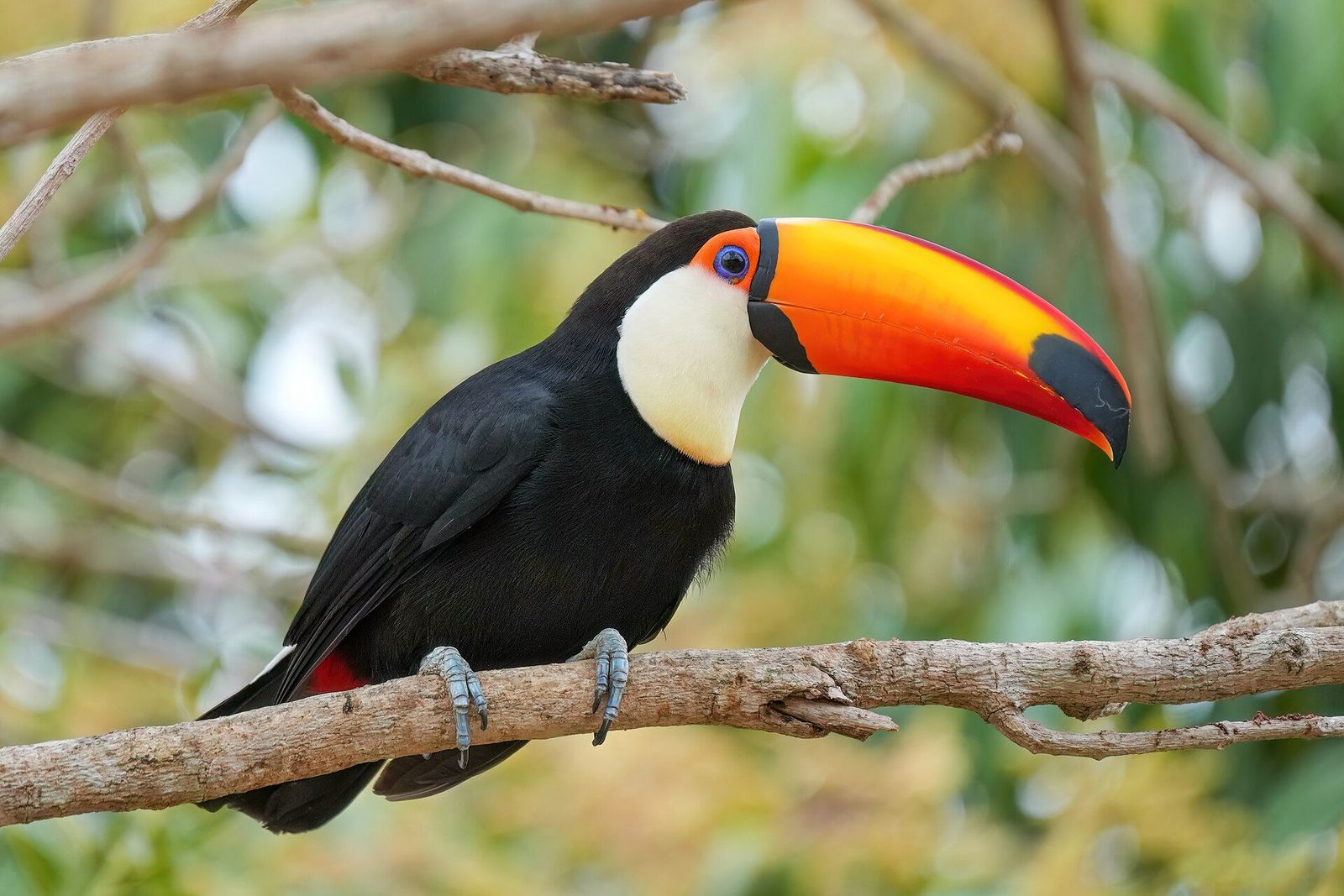
Toco Toucan
Meet the Toco Toucan
Imagine carrying a bright orange bill about one-third as long as your whole body! The toco toucan, the world’s largest toucan, does exactly that, and its giant bill is full of surprises.
General Information
- Common Name: Toco Toucan
- Scientific Name: Ramphastos toco
- Animal Group: Bird
- Size: About 21–24 inches (55–61 cm) long, bill included. The bill alone is about 5.7–9 inches (14–23 cm).
- Weight: About 1–1.9 pounds (500–860 grams)
- Lifespan: Unknown in the wild; in zoos, often 8–9 years, sometimes up to 18
- Diet: Mostly fruit, plus flowers, insects, spiders, small lizards, and the eggs and chicks of other birds
- Active Time: Daytime
Toco toucans have black bodies, a white throat, and bare orange and blue skin around each eye. They usually travel in pairs or small groups, searching for fruit.
They nest in tree hollows, holes in stream banks, and termite mounds opened by other birds. The female lays 2 to 4 white eggs, and both parents keep them warm for 17 to 18 days. Chicks hatch bare and blind and stay in the nest about 6 to 8 weeks.
IUCN Conservation Status
The IUCN Red List helps us understand how likely an animal species is to disappear forever.
- This Animal’s Status: Least Concern (LC)
- Assessment Year: 2025
- Population Trend: Decreasing
Toco toucans live across a huge area, so they are not in danger right now, but their numbers seem to be slowly shrinking. Trees are being cleared where they live, some are hunted, and young birds are taken from nests for the pet trade. Families can help by never buying wild-caught birds and supporting groups that protect South America’s wild places.
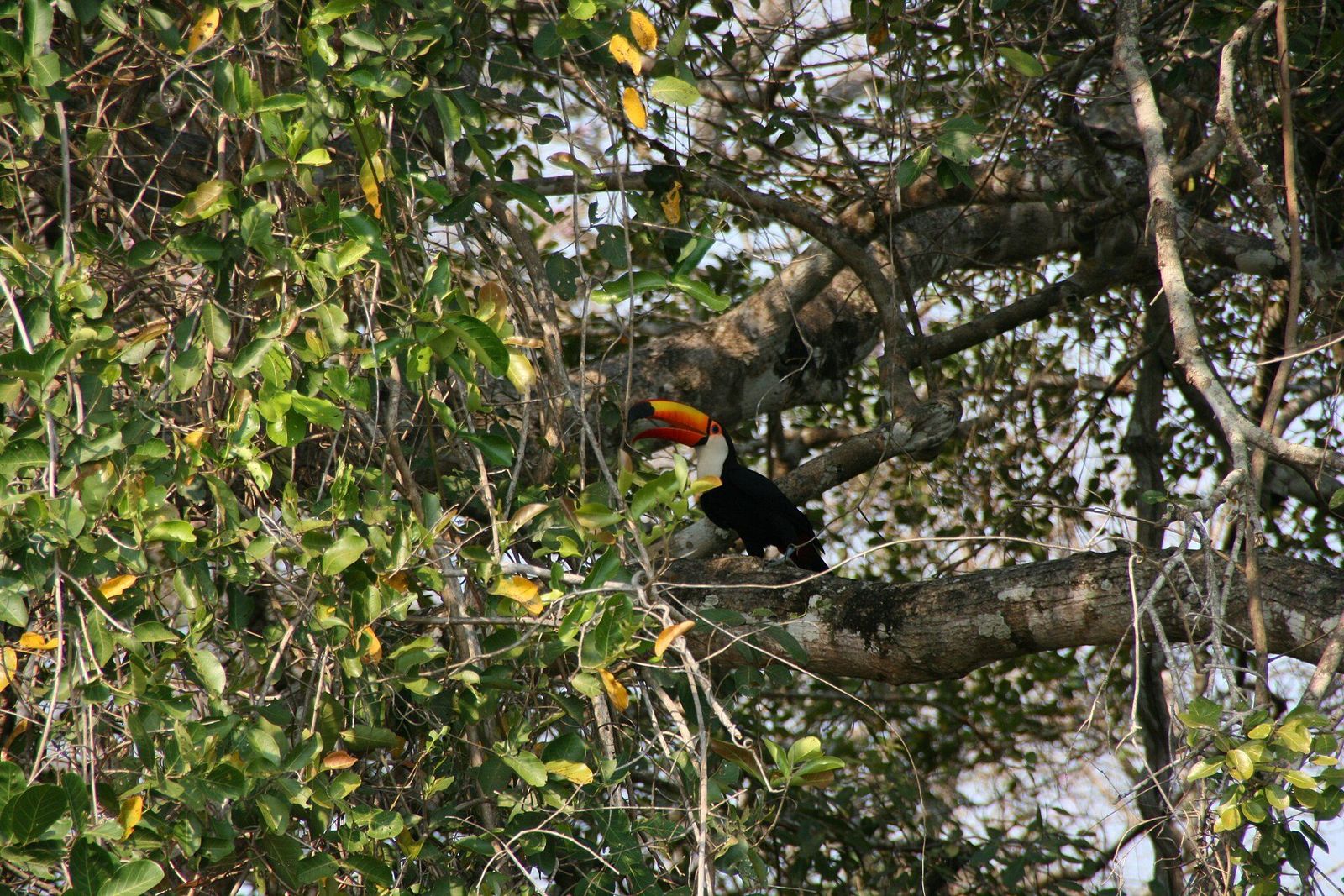
Habitat: Where Does It Live?
Toco toucans live only in South America. They are found in Brazil, Bolivia, Paraguay, Argentina, Uruguay, Peru, and the Guianas (Guyana, Suriname, and French Guiana).
Unlike other toucans, tocos prefer semi-open places with scattered trees instead of thick rainforest. Picture Brazil’s cerrado, a grassy savanna dotted with trees, or strips of forest along rivers in the Pantanal wetlands. They also visit orchards and city gardens.
Fun Facts
- Toss and gulp! A toucan grabs fruit with its bill tip, then flips its head back to swallow it.
- Feather ball bedtime! To sleep, a toucan lays its bill on its back and folds its tail up over itself.
- Big but light! That huge bill is only about one-twentieth of the bird’s weight.
- Pencil-sized bill! A big male’s bill can be about as long as a new pencil.
- Frog-like voice! Toco toucans grunt, croak, rattle, and clack their bills.
- Tree planters! Tocos spread seeds of manduvi trees, where hyacinth macaws later nest.
- Famous first! The toco was the first toucan European explorers saw, in 1555.
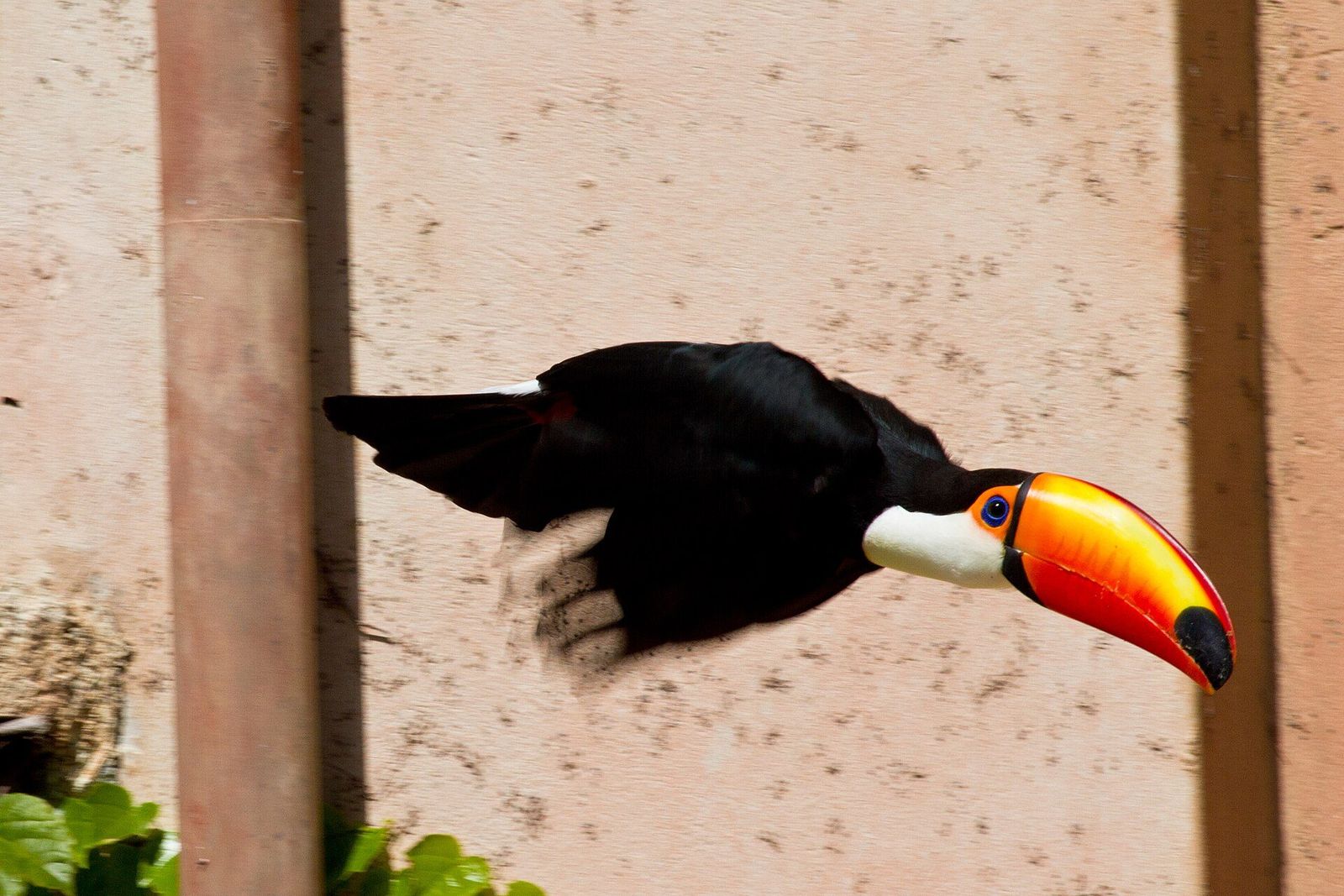
Amazing Design Features
A Bill That Shares Heat
The bill is full of blood vessels and has no feathers to hold heat in. When the bird is hot or flying, it sends more blood into the bill so heat escapes into the air. When it’s cool, it cuts back the blood flow to save warmth. Like an adjustable radiator, the bill can handle anywhere from 5 to 100 percent of the bird’s heat loss.
Light but Strong
The bill’s outside is made of keratin, the same material as your fingernails, arranged in tiny overlapping tiles. Inside is a lightweight, bony foam held up by crisscrossing fibers. This “sandwich” makes the bill stiff and strong but light.
A Long Reach
The long bill works like kitchen tongs. Toucans use it to pluck fruit from nearby branches and reach into tree holes.
Grippy Feet
Toucans have two toes pointing forward and two pointing backward. This gives a firm grip for climbing branches and tree holes.
Strong Neck
A strong head and neck let a toco pull, shake, and twist, and it can even hang upside down. God fitted this bird well to work that big bill.
A Look at God’s Creation
The toco toucan reminds us that God is a creative and generous provider. Psalm 104:12 (NIV) says, “The birds of the sky nest by the waters; they sing among the branches.” Psalm 136:25 (NIV) praises God: “He gives food to every creature. His love endures forever.” Scientists observe toucans eating fruit; the Bible teaches that God is the giver behind every meal. We honor Him by caring for the places these birds need.
- IUCN Red List: Ramphastos toco (Toco Toucan) assessment (2025)
- San Diego Zoo Wildlife Alliance Library: Toco Toucan Fact Sheet
- San Diego Zoo: Toucan
- Animal Diversity Web: Ramphastos toco
- Science: “A Bird With a Big Air-Conditioning Bill” (on Tattersall et al., 2009)
- Seki, Bodde & Meyers (2010), “Toucan and hornbill beaks: a comparative study” (PubMed)
Photo credits (Wikimedia Commons): Giles Laurent (CC BY-SA 4.0); Marco Zanferrari from Doha, Qatar (CC BY-SA 2.0); Axel Bührmann from Fourways, Gauteng, South Africa (CC BY-SA 2.0). Full photo credits